MultiLAwa – Multilingual Language Awareness in the European Digital Society
Identification
- Project identification: MultiLAwa – Multilingual Language Awareness in the European Digital Society [Grant agreement ID: 101310669]
- Coordination: Prof. Alex Boulton, and Prof. Hélène Vinckel-Roisin (Université de Lorraine)
- Responsible at CLUNL: Rute Costa (Lexicology, Lexicography and Terminology research group)
- Duration: 2026 – 2030
- Funding entity: Horizon Europe, Marie Skłodowska-Curie Actions Doctoral Networks (MSCA-DN)
- Website: https://www.multilawa.eu/
Description
Today’s European society faces major challenges with far-reaching implications driven by rapid digital transformation and increased mobility, such as linguistic inequality in education, the lack of linguistic diversity in academia, business and governance, the widening technology gap between well-resourced languages and less-resourced languages, biases and stereotyped language (e.g. related to gender, race) conveyed by digital tools and AI technologies. These alarming developments call for urgent action.
MultiLAwa advances pluri-/multilingualism as a key driver of social cohesion and inclusion by promoting Language Awareness (LA) – the explicit and implicit knowledge of language(s) and language use – across individual, institutional and societal levels.
Going far beyond existing research and doctoral training initiatives, the project’s overarching objective is to analyse the interconnections between LA, pluri-/multilingualism and digital transformation, and to translate this knowledge into practical solutions by:
- Investigating how LA can serve as a competence for navigating Europe’s digital transition, and how digital progress can foster LA and pluri-/multilingualism;
- Developing new theoretical, methodological and empirical foundations for LA in the digital age;
- Creating innovative digital resources and guidelines to raise LA and thus enhance pluri-/multilingualism.
Bridging the gap between academia and industry, MultiLAwa brings together 10 European universities and 15 associated partners (including 10 non-academic organisations) in an exceptional multi-stakeholder consortium. MultiLAwa will train a new generation of 14 young plurilingual researchers to become experts capable of addressing language-related challenges in a rapidly digitalising society – contributing to sustainable, inclusive and pluri-/multilingual ecosystems across Europe.
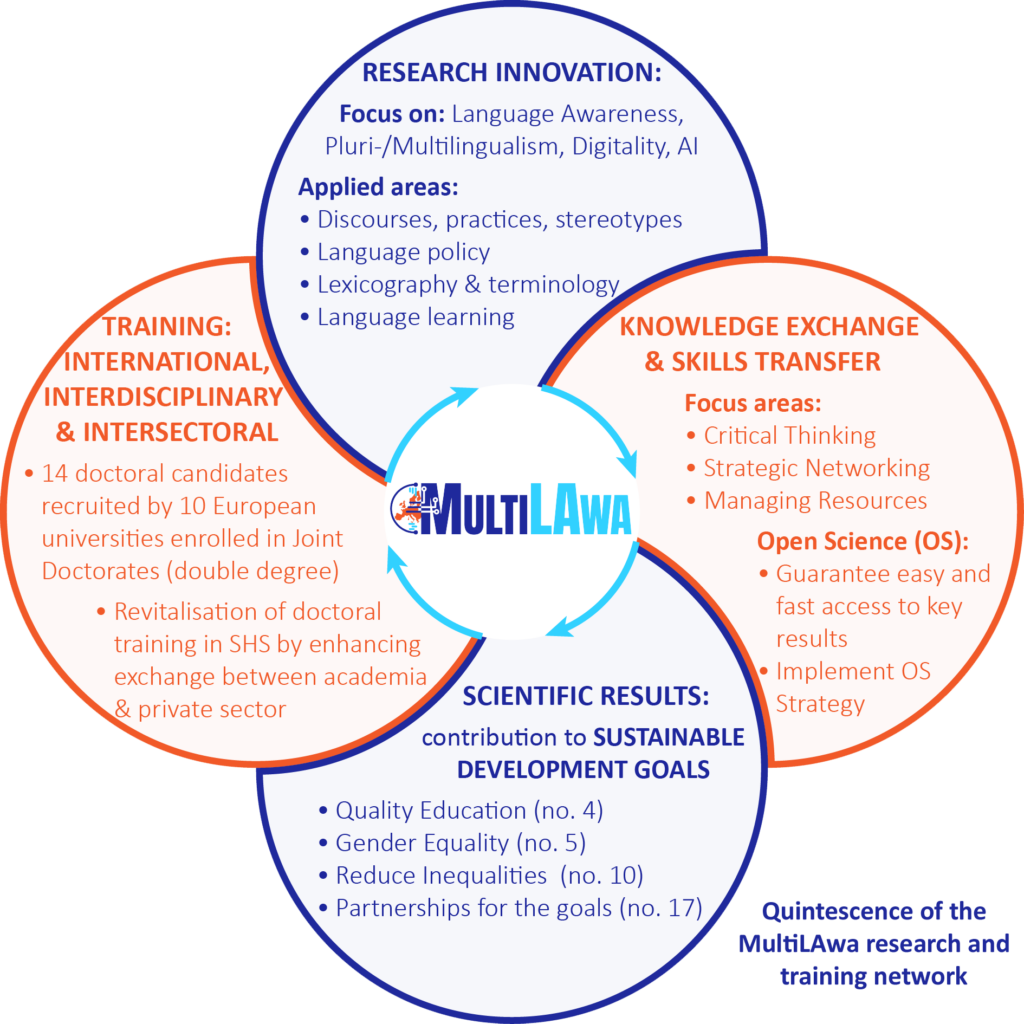
MultiLAwa research and training programme fully fit in the Social Sciences & Humanities panel (main focus on: Linguistics – Use of language + Comparative linguistics, – Education): the consortium gathers beneficiaries and Associated Partners with profound expertise in various linguistic, educational and sociological approaches and skills from complementary subdisciplines – first of all: (Applied) Linguistics, Digital Linguistics & Language Technologies (AI, NLP, Computational Linguistics), Gender Linguistics, Interactional Linguistics, Sociolinguistics, Lexicography, Terminology, LSP, Didactics and Language Policy. The research programme will also integrate expertise data, techniques, tools, concepts and theories from other scientific disciplines, in line with the targeted stakeholders of MultiLAwa’s key exploitable results: Economic Sciences (Finance), Information Science and Engineering (AI and Multimedia), Environmental and Geosciences (Circular Economy). This interdisciplinary approach is unique and unprecedented in doctoral programme in Europe.
[Retrieved from: https://www.multilawa.eu/about/]
CLUNL team
Rute Costa (Responsible at CLUNL)
Menu < back
- Projects
- Ongoing projects
- MultiLAwa – Multilingual Language Awareness in the European Digital Society
- SPELL2 – Synchronizing Perceptual and Lexical Abilities in Second Language Acquisition
- Escola da Palavra: (re)significar a vida pela palavra
- MultiPoD – Multilingual and Multicultural Spaces for Political Deliberation
- HEREDITARY – HetERogeneous sEmantic Data Integration for guT-brAin interplay
- TTC-CPLP – Terminologias Técnicas e Científicas para a CPLP
- CHAMUÇA – Portuguese and South Asian Lexicon Archive
- DiTo – Didática do Texto
- REDGRAM – Digital Resources for Education – Grammatical Pathways
- iRead4Skills – Intelligent Reading Improvement System for Fundamental and Transversal Skills Development
- Investigating the impact of implicit and explicit instruction on phonological acquisition in a second language
- LAUA – Language Attrition and Ultimate Attainment
- CORRELATE – Corpora and Lexical and Terminological Resources
- TERMVEST – The Clothing Terminology: European Portuguese version
- POR Nível – Design and validation of a placement test to PFL
- Cultural Heritage Lexicon
- Concluded projects
- EPISTRAN – Epistemic Translation: Towards an Ecology of Knowledges
- NObarriers2Health: Reducing language and cultural barriers through machine translation literacy for inclusive multilingual health communication
- Heritage Languages go to School: The interplay of (extra)linguistic factors in successful language development
- ProPerL2 – Production and Perception in L2 speech learning
- Active Citizenship Through Dialogue in Virtual teacher communities
- ANACOREX – Anafora y expresiones referenciales en el bilinguismo: triangulando enfoques de corpus y experimentales
- G&T.Comenta
- Language and literacy at school – the contribution of metasyntactic abilities to reading comprehension development
- EXPRIMI
- LL2DS – Linking Linguistics to Data Science
- MorDigital – Digitisation of Diccionario da Lingua Portugueza by António de Morais Silva
- Humanities Going Digital (HUGOD)
- QuILL – Quality in Language Learning
- Western Sephardic Diaspora Roadmap
- Caring Communication: gene therapy in the context of hemophilia
- Monitor Corpora. PressCoronaVírus
- COVID-19 Collaborative Glossary
- Com@Rehab – Communication for interactive rehabilitation in virtual reality
- Project GiroFLE
- OrthoDef
- PIPALE – Preventive Intervention Project for Learning to Read and Write
- Digital Edition of the “Vocabulário Ortográfico da Língua Portuguesa” (VOLP-1940)
- Read4Succeed: Improving migrant, refugee and from deprived neighbourhood children reading skills through an Animal Assisted Reading program
- CoRaLHis – Comparing Romance Languages through History: building a multilingual parallel diachronic corpus (13th-18th C.)
- Corpus Linguístico & Avatar para a Língua Gestual Portuguesa
- ELEXIS – European Lexicographic Infrastructure
- MOCOLANG-O – MOdélisation COnceptuelle des troubles (du LANGage et de la communication) en Orthophonie
- ANACOR: A corpus-based approach to anaphora resolution in second language acquisition: beyond the interfaces
- European Portuguese-Standard Arab Dictionary
- Romance clitics in diachrony. An integrated approach
- Portuguese Literature Corpus for Distant Reading
- ALPROF – Automatic Assessment of Language Proficiency for Migrant Integration
- CLARIN CLUNL
- Utopia, Food and the Future
- Development of syntactic structures in Portuguese and French monolingual and bilingual acquisition
- The Case of Grammatical Relations
- BlackBox – a Collaborative Platform to Document Performance Composition: from conceptual structures in the backstage to customizable visualizations in the front-end
- Promotion of scientific literacy
- PerGRam – Percursos para o ensino da gramática nos primeiros anos de escolaridade
- Knowledge Organisation Proposal within the scope of infertility: the role of Terminology
- Subordination in Medieval Portuguese
- Crosslinguistic and Crosspopulation approaches to the Acquisition of Dependencies
- Syntactic and lexical factors in processing complexity
- SIERA – Integrating Sina Institute into the European Research Area
- Syntactic Dependencies from 3 to 10
- Events and subevents in Capeverdean
- TKB – Transmedia Knowledge Base for Contemporary Dance
- Research network projects
- ELEXIS Association
- PhraConRep – A Multilingual Repository of Phraseme Constructions in Central and Eastern European Languages
- Y-JustLang – Justice to youth language needs
- ENEOLI – European Network On Lexical Innovation
- Consortium Huma-Num ARIANE
- GRAFE’Maire
- e-Term ANCV – Recurso terminológico jurídico-parlamentar digital Assembleia Nacional de Cabo Verde
- Metalex – International Metalexicography Network
- @ Cientista Regressa à Escola
- CLIL in Languages Other Than English
- NexusLinguarum – European network for Web-centred linguistic data science
- Distant Reading for European Literary History
- HL2C – Heritage Language Consortium
- KEYSTONE – Semantic Keyword-Based Search on Structures Data Sources
- ARLE – International Association for Research in L1 Education
- ENeL – European Network of e-Lexicography
- GraMaLL – Grasping Meaning Across Languages and Learners
- Language Impairment in a Multilingual Society: Linguistic Patterns and the Road to Assessment
- GIRTraduvino – Grupo de Investigación Reconocido sobre la Lengua de la Vid Y el Vino y su Traducción
- Value for Health CoLAB
- Infrastructures
- Services provision
PT